
 Tweet
Tweet
Originally posted by cikljamas
View Post
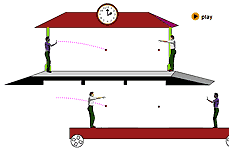
Let's look at a situation inspired by Galileo's example. An observer on a train moving smoothly with velocity v either drops a ball or throws it horizontally with speed -v, ie with speed v in the opposite direction. We can compare this with an observer on the platform who either drops a ball, or who throws it (forwards) with v. We show the two points of view. Galileo chose lead or rock as the material so that the weight of the projectile would be much greater than the forces exerted on it by air. In our animation, air resistance is neglected.
Press "Play" in the link provided:
Galilean relativity and Newtonian mechanics (from Einstein Light)
Originally posted by cikljamas
View Post
Earth's_rotation
Earth's Velocities
Astronomers believe the "Earth" is moving at approximately 630 km per second with respect to this local co-moving frame of reference.
Milky Way - Wikipedia, the free encyclopedia
The Earth is traveling at an average speed of 828,000 km/h (230 km/s) or 514,000 mph (143 mi/s) relative to the galactic center
Galactic year - Wikipedia, the free encyclopedia
Al
 He must feel proud to his superpower; the airplane is consuming propellers and he is not! In reality, and in the first moment, he will realize that the airplane is ahead of him and he is left behind in air because the inertial motion is terminated by the presence of air. Argue or not, it is well-known fact since the ancient civilizations. In the presence of air atmosphere, the law of inertia does not function. If you threw an object aloft several meters, it will come back to your hand; not because of the law of inertia but because


Comment