-
-
Free Video from Conference Available Now
TOPICS- FREE Video from 2014 Energy Science & Technology Conference
Hi Friends,
The 2014 Energy Science & Technology Conference was an incredible success! Many are saying it is the most important conference they have been to in their lives from any category of conference.
I drove a total of 3478 miles round trip to attend the convention and was able to personally talk with, and ask questions of, all the presenters. I really appreciated the opportunity for the one on one contact and getting to see the equipment and demonstrations up close and personal! Thanks for holding the convention and thanks to all the presenters! It was time, energy and money well invested.
As a fabricator and builder the conference was a bit overwhelming but the connections I made were well worth the trip. I would go again and look forward to your next one.
FREE Video from 2014 Energy Science & Technology Conference
To view this free video from the conference, you must be a subscriber to the Energy Times newsletter. If you are already a subscriber, you will receive an email with the viewing instructions. If not, go here to watch the video: Energy Times by Peter Lindemann & Aaron Murakami
After you click the confirmation link in the email that comes, the first newsletter will have the video link and password. Make sure to give the video a thumbs up to show your support for all the speakers!
In the first hour, Jim Murray shows the various machines he built and tested over the last 35 years that lead to the understanding of how to build the SERPS device. In the second hour, Paul Babcock explains the theoretical operations of the SERPS system showing how it borrows, uses, and returns electrical power to the source.
The presentation then switches to a clip in the exhibit room where the working model was running and demonstrating It ends with a Q&A by Paul back in the meeting room. A separate PDF file of all of the slides shown in the Power Point Presentation will be included.Sincerely,
Aaron Murakami
Books, Videos, ESTC Conference Info, Blog, etc. https://emediapress.com
Comment
-
Thank You Mark
Hi Mark
Thank you for giving us all a little more on the circuit layouts. It all counts as we wonder how this circuit has achieved such great results. I have never been to EE school and can not design high quality circuits yet but i have seen enough diagrams to know what it takes to produce 2 waves like working side by side and fully adjustable.
I was completely and utterly amazed to see that scarey wave, well the way it adjusted up and around was real freaky for me.
These guys got a lot on the ball I hope they make it big and get plenty of green backs to fund their operation before the bell rings for them.
We are all getting older and these guys are not spring chickens so it is time to get in on. Well I am sure they would like to see their unit excell and yet are very wise men about what it takes to stay out of the way.
The set up is not that big for such powerful results and the TTL logic gates, counters, synthesizers, computers, also amplify.
Transistor ------To-----Transistor------Logic.
7400 family and more for those in the know. Hey out there to some of those reading in, just because I know doesn't make me a heavy all it means is I am on the beginners page for those who think the message makes me smart somehow. It doesn't.
I am aware of devices that is it.
Mark you know about the "High speed", low power schottky lower power, fast advanced schottky and on we go.
"Mark Wrote: composed of an IGBJT and an SCR in series"
Well I won't touch that one is out of my understanding other than using them one behind the other to produce the proper pulse train.
With all of that in mind it is not enough to replicate a mans life's work that could take someone 50 years to figure out. Look at all of the ED Gray stuff to work with still no one can do what he did.
To me this is like making music. No two musicians will sound the same yet each one can come up with the desired effect so these two are just another
success story that show we all might do it another way just as well.
Thanks again for letting us in on what you saw.
MikeComment
-
Hi Spokane1,
thank you for sharing all the interesting info. Question, was the power transformer standard, meaning closed core? Or were the windings on an open core?
I ask because closed cores are terrible for resonant experiments.
I have done a few experiments now in trying to replicate the serps circuit. The problem was making a circuit where one could adjust all the variables of the single quadrant signals, and to be in phase with the power signal.
Since I'm an audio engineer I had the idea of recording the signal on a digital multitrack software. Basically one track with the main sine wave whose output would go to a power amplifier feeding the transformer. The other four tracks would have square waves of about 20% duty cycle which I could shift back and forth individually in real time while watching the result of the power circuit on the scope.
The power circuit basically was composed of two parallel circuits, one for the positive part and one for the negative. Each circuit would have 2 opto controlled transistors (controlled from the multitrack output). One going in one direction to charge the cap and one in the other to discharge back to the transformer. So 4 trannies total.
I used an open core transformer because I knew it would work well with resonance experiments.
The result was that I could simulate very well a resonant condition, basically what I would get from a non switched resonant tank circuit, but here I could switch when I wanted to.
When I would insert the load I would have to adjust the cap size and readjust the quadrant signal position, but I never got more out then in.
Basically what you get when you insert a load into a tank circuit and try to retune the freq for minimum consumption at the input and max power in the tank with series load.
Then I saw the picture with the new waves posted here (Babcocks?)and someone started talking about series discharging the cap. I already knew this from tesla switch type experiments I had done before.
I did a very crude setup working only on the positive side to see what I would get, know what? I could replicate the waves! So for me this is the way to go.
I am putting together a new setup that basically does what the Ron Cole bipolar switch does (THE TESLA SWITCH ) but with an AC transformer as the source. Since this is AC I will replace each transistor with two series mosfets (search mosfet setup for AC). I will use 6 optos, and each output will have its own micro DC-DC supply for switching the fets at the correct times.
I'll post a schematic when I get time..
One more thing, I'm kinD of surprised no one (maybe I missed it) has made the connection to Bedinis energizer... The concept is the same. when the magnet approaches the coil it charges a cap through a load. At the right time (which is when the SG normally fires) the cap discharges through the load into the coil making the generator coil become a motor for a moment. Basically you have a generator that barely puts any drag on the rotor, this is why the motor designed to drive the rotor only has to drive a "freewheeling" rotor. At least this is how I see it.
regards,
MarioLast edited by Mario; 07-16-2014, 01:35 PM.Comment
-
SERPS Transformer
Dear Mario,Originally posted by Mario View Post
The power transformer used appeared to be an "off the shelf" control power transformer typical of designs seen here in the US. It was about 7" high, 6" wide, and 6" deep. It looked like a common closed "E" core shell type unit. It was all black, which is typical here. Paul said it was rated at 1 kVA - which was in agreement with my estimate. I do not know what its turns ratio was, but since the input was 120VAC and the light bulbs were operating at 120 VAC it was either an isolation transformer or a 1:2 w/ center tap design, to feed the two capacitor banks.
Your plans for an attempted reverse engineering verification circuit sound interesting. I agree with you that this system seems similar to the "Tesla Switch" concept.
Paul did say that the control sequence for this device was controlled by a string of NE555 timers. The starting logic signal was established by a voltage comparator (zero degree crossing detection) that triggered the first NE555 for a count down time of 4.16 ms to gate the first IGBJT/SCR switch. I got the impression that this time was adjustable so that the switch action would start to take place a head of the actual time the switching was needed. Thus all the delays in the various control elements could be compensated for in advance. This first switching event would then trigger the next NE555 for its compensated time period to switch the next channel and so on.
To make this approach work this circuit has to rely on the precise timing of the Grid 60 Hz signal.
I don't know for sure, but the power transformer would have to operate mostly on a 60 Hz frequency. I'm sure there are a lot of other higher frequency components generated from the quadrant chopping scheme. If this kind of transformer were operated very much outside of the 60 Hz. band it would probably heat up. At the 50 watt level this is not an issue in this demo device.
I also heard that the transformer was needed to provide isolation for the power analyzer.
Spokane1Comment
-
Thank you Spokane1. It could well be that with a Tesla switch type approach, meaning charge in parallel discharge in series, a standard transformer would work.
I can kind of see the timing method with 555's etc... I took the faster and easier route with recorded tracks, at least to experiment until I see a result.
You also aswered another question i had but forgot to ask, the rated voltage of the bulbs, thanks
regards,
MarioComment
-
Reverse Engineering Challenges of Novel Technologies
Dear Mike,Originally posted by BroMikey View Post
I don't know to much about the SERPS device, but I think I know about as much as anybody about what is left of the E. V. Gray technology.
True, we do have in custody 3 motors. Unfortunately they were butchered in 1980 and thus all of the novel OU innovations were destroyed. What we have left are just historical boat anchors.
According to the recent George Durnford Transcript, Mr. Hackenberger claims that the transformer in the DC-DC converter is the source of the magic. We know very little about that component. Without this piece all the rest of the surviving hardware is useless.
From my current perspective we know much more about the SERPS device than we do about the Gray transformer. Because of this, no one has been able to duplicate the performance of the Gray technology.
As a side note Gray couldn't duplicate the performance of this equipment either after Mr. Hackenberger died in early 1980.
Mark McKayComment
-
Ed Gray Transformer missing
Hi MarkOriginally posted by Spokane1 View Post
Yes it is a shame that this transformer was never recovered. From what I recall of the history he made special ones that were kept a secret.
I see guys winding up what they call Tesla style with clothe in between rows some using wide spacing using the clothe to do it. Durin or can't think of that name of the plastic that was used to make the transform do things we can't understand today.
It seems we looked long and hard at the circuits thinking the secret might be there when all of this time the transform was underrated.
I think the spark gap was a way to form an oscillation but was not the key.
Back in those days Tesla did not have transistors so he used magnetically quenched spark-Gaps to produce oscillations in the megahertz and this was a great device to replace a transistor.
I could be wrong about that, this is all I have thought of concerning the spark-Gap. Of course Tesla had low voltage commutators as well as higher voltage wheels with lobs but there is a point reached where wheels with contacts can only go so high in frequency.
From there the spark Gap went higher in frequency with great easy plus could handle a substantial amount of power in the form of a high voltage discharge.
Like the Tesla coil has also a way to discharge the coil using the device called a SPARKGAP, can not low key the importance of the coil that is an energy storing component.
The thought occurred to me that a KapaGen uses a series of step up and down transformers with loose coupling plus a sparkGap to operate the high voltage section and how Gray did the same thing and fed the output into a motor. Joe Newman claims he has an electrostatic engine as well.
It seems that operating in the higher voltage ranges is very important.
For awhile I thought the sparkGap did the magic but what it does is make a path for the low voltage and the high voltage to interact for good reason, charging the batteries and relieving the circuits so they didn't overload, plus form the high voltage unidirectional impulses.
This is all I am good for or as far as I have come in putting two and two together. I have no idea what is going on with these many units reported to go OU.
All I know is something happens and by accident a few have found what they call a strange anomaly at first and then when they can repeat it the inventor calls it by his own name. We might call it the "Tesla effect" but we have no "Tesla Effect" all we have are the names that go with the "UNDERUNITY EFFECTS" maxwel, hertz, Einstein and so on.
As long as it burns current it can be shown on a meter and therefore money must be paid for something we all burn up
MikeLast edited by BroMikey; 07-17-2014, 07:58 PM.Comment
-
The Secret of Tesla's Power Magnification
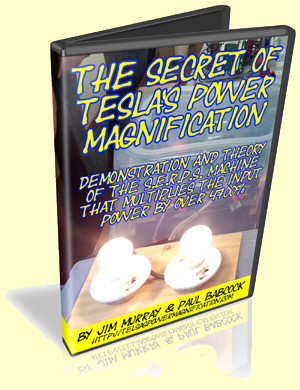
We're honored to be able to release Jim Murray and Paul Babcock's presentation from the 2014 Energy Science & Technology Conference! This is one of the most, if not THE MOST, anticipated video presentation we have ever made available. Jim & Paul teach the science behind the SERPS (Switched Energy Resonant Power Supply) device, which has the highest publicly demonstrated COP's that we know of.
The title of the final presentation release is -The Secret of Tesla's Power Magnification. It's 2 Hours Long and we're even including a PDF of the powerpoint for the presentation so you can see everything up close and clear.
Get your copy now: The Secret of Tesla's Power Magnification by Jim Murray & Paul Babcock
At the conference - Paul Babcock's replication of Jim Murray's SERPS device using his own patented high speed switching method was producing 52.7 Watts of dissipated energy in two light bulbs while the net draw from the power transformer was only 1.1 Watts! That is a COP of 47.9 or 4790% more energy dissipated in the light bulbs than the net draw from the power supply.
This information represents the first public display and explanation of this technology in all of history. Even Tesla never showed this much about how to accomplish these effects.
Get your copy now: The Secret of Tesla's Power Magnification by Jim Murray & Paul Babcock
Sincerely,
Aaron @ White Dragon PressSincerely,
Aaron Murakami
Books, Videos, ESTC Conference Info, Blog, etc. https://emediapress.com
Comment
-
Just finished watching the video.
It was informative and Jim and Paul are engaging talkers.
They gave some good details but of course no explicit circuits.
The one thing that kind of caught my attention was that if I understood correctly, Jim said that in the original SERPS demo, the negative power reading was not correct and a machine glitch?
According to the inequality in the video:
(Power from Source to Load) + (Power returned to Source from Load) > (IxR^2 + IxR^2)
It is basically a power reflector and it can not reflect back more power than it receives. So Stefan's statement that the load would have to somehow be turned into useable energy is correct to get a self-runner if this is correct.
So it is impossible for the SERPS to generate negative power (return more power to the source than it receives).
There was a little diagram by Paul which he demonstrates how he saw Tesla "magnifying" the power, so in that diagram, he showed the Load being an inductor to a transformer. So there it is possible to run inductive loads it seems and not just resistive loads.
Overall, a good video but you're not going away with a circuit to try out. But no matter, that pretty much has been revealed in this thread anyways.
Thanks Aaron for putting it all together. Always enjoy hearing Paul and Jim talk.Comment
-
Magnifier
Thanks Silver..............Originally posted by SilverToGold View Post
For the synopsis of the video. With that in mind I found this on Tesla's Magnifying Transmitter, most of the people on these forums have seen this but I didn't think it would hurt to bad to review.
Tesla Magnifying Transmitter configurations. - YouTube
MikeComment
-
You're welcome Mike. I love the guy's accent in that video.
To be clear, Paul did not talk about how the Tesla Magnifying Transmitter worked.... just how Tesla powered it. They were talking about a comment Tesla made under oath in court that he could basically magnify 100 hp by like 5 million times (if I remember correctly). And they relate that it was by the same SERPS technology that they rediscovered.
Originally posted by BroMikey View PostComment
-
Russian Video
I think the OLD SCIENTIST is Russian not for sure but did you see the end where he went to a square wave? It raised the voltage way up in his cap using a 50 percent duty of the same voltage as before.Originally posted by SilverToGold View Post
So if we could use the SERPS tech to conserve further on energy input that should be OU many times.
In the beginning I followed John bedini because he talks about simple square waves and how by themselves are an improvement over direct current flows.
I know this is elemental . I had never thought about it much till John shows how to build an SG OSC various ways and so I sampled the operation of this invention for many hours hooking to batteries.
Right now i am spending long hours using conventional direct current to charge caps and I can tell you the there is no comparison whatsoever.
The Oscillators using the big coil boost format takes the cake for me.
I can hardly wait to finish this dump box so i can finish the other half of the SG Osc in solid state form.
These two devices are only a small piece of what will be needed to get higher COP. Well what I am getting to is that using and perfecting these low voltage units could drive coils for high voltage to a gap and back down for use at 120vac.
The OLD SCIENTIST showed what he called a Magnifying bifilar Tesla Coil. Grounding to earth is another hurdle to cross.
MikeLast edited by BroMikey; 07-18-2014, 02:34 AM.Comment
-
The method isn't being disclosed, and I find it unfortunate, but this is was expected. I can and do respect that the inventor(s) must protect their interests and the that of their investors, investor isn't limited to those who fund your research. With that being said, I don't think its necessary to try and figure out what they are doing, I think it wiser to find a similar method, one which is by no means the same thing, but could be considered as a step in a similar direction.
I offer the following, not for discussion, I offer it simply for your private contemplation and consideration.
RegardsComment
-
Serps
Most people are familiar with power magnification in the Magnifying Transmitter but not many knew that he was magnifying power in generators. That is more what this presentation is about is Jim & Paul's ideas of how Tesla did that based on very strong evidence in Tesla's work and an actual working model. The SERPS may not be 100% how Tesla did it with his generators, but the SERPS certainly does exactly what Tesla explained in terms of what is necessary to accomplish it.Originally posted by SilverToGold View Post
That "Tesla Wave" or I'd say Tesla Waveform is really a big deal - that waveform on the 1.1 watt graph on the side of the plastic bin. If someone focuses on just accomplishing THAT they'll be further along than most.Sincerely,
Aaron Murakami
Books, Videos, ESTC Conference Info, Blog, etc. https://emediapress.com
Comment
This forum is preserved as a permanent archive. The community continues at eMedia Press.
- If this is your first visit, be sure to check out the FAQ by clicking the link above. You may have to register before you can post: click the register link above to proceed. To start viewing messages, select the forum that you want to visit from the selection below.

 Tweet
Tweet
Comment