This forum is preserved as a permanent archive. The community continues at eMedia Press.

Announcement

Collapse
No announcement yet.

Interesting Pictures of the Sun

Collapse
X
 
  • Filter
  • Time
  • Show
Clear All
new posts

  • MonsieurM
    replied
    IndianaBoys , is there a way to see if the solar triangle is still visible .... and if so where the filament would be relative to the solar triangle


    would be curious to see that

    here is a nice website to find the coordinates (maybe ) of the solar triangle and the solar snake

    Solar Rotation

    the regions of the Sun near its equator rotate once every 25 days. The Sun's rotation rate decreases with increasing latitude, so that its rotation rate is slowest near its poles. At its poles the Sun rotates once every 36 days !
    Last edited by MonsieurM; 08-07-2012, 10:35 PM.

    Leave a comment:


  • MonsieurM
    replied
    Originally posted by IndianaBoys View Post

    Amateur astronomers around the world are monitoring a gigantic filament of magnetism on the sun. If one end of the filament were on Earth, the other end would reach all the way to the Moon. The dimensions of the structure make it an easy target for amateur solar telescopes. Richard Fleet sends this picture from his backyard observatory in Wiltshire, England.

    This filament is filled with billions of tons of plasma, yet it has remained suspended above the surface of the sun for days. Such a massive structure, buffeted as it is by winds and currents in the sun's atmosphere, is unlikely to remain stable much longer. If the filament collapses, it could crash into the surface of the sun and spark a powerful type of explosion called a Hyder flare. Amateur astronomers are encouraged to monitor developments.

    Hyder Flare
    IPS - The Sun and Solar Activity - Hyder Flares

    IndianaBoys
    wow ....... .... Impressive IndianaBoys

    Leave a comment:


  • SYDERA
    replied
    Sun

    Thanks for all the wonderful pics and information, very much appreciated- Im loving it IBs
    Such beautiful phenomenon
    S

    Leave a comment:


  • IndianaBoys
    replied


    One rather small active region popped off no fewer than 15 minor flares over 18 hours (July 30-31, 2102). The activity of diminutive sunspot AR1538 is a sign of tension in the region's magnetic field. The active region show to the right also contributed another three flares during the same time period. The images were taken in a wavelength of extreme ultraviolet light.


    Solar flares today July 31, 2012
    Today, 12 solar flares were observed:

    Active region Begin, UT Max, UT End, UT
    Flare of class C1.8 1532 01:48:00 01:51:00 01:54:00
    Flare of class C1.0 1536 03:28:00 03:34:00 03:35:00
    Flare of class C1.1 1535 09:35:00 09:40:00 09:57:00
    Flare of class C5.7 1535 10:46:00 11:30:00 12:26:00
    Flare of class C5.0 0 14:17:00 14:25:00 14:30:00
    Flare of class C1.6 1536 15:10:00 15:15:00 15:22:00
    Flare of class C1.3 1538 15:54:00 16:02:00 16:07:00
    Flare of class C4.0 1536 17:10:00 17:27:00 17:32:00
    Flare of class C1.2 1535 19:25:00 19:30:00 19:35:00
    Flare of class C2.4 1528 21:59:00 22:05:00 22:08:00
    Flare of class C1.3 1538 23:29:00 23:33:00 23:36:00
    Flare of class C1.3 1536 23:54:00 23:59:00 00:04:00

    Solar flares yesterday July 30, 2012
    Yesterday, 14 solar flares were observed:

    Active region Begin, UT Max, UT End, UT
    Flare of class C1.5 1528 00:47:00 00:54:00 01:01:00
    Flare of class C1.1 1532 01:49:00 01:53:00 01:56:00
    Flare of class C2.4 1528 04:16:00 04:24:00 04:28:00
    Flare of class C1.3 0 05:14:00 05:17:00 05:21:00
    Flare of class C4.0 0 06:03:00 06:12:00 06:22:00
    Flare of class C2.4 0 07:06:00 07:10:00 07:16:00
    Flare of class C1.6 0 07:54:00 07:58:00 08:01:00
    Flare of class C2.1 1528 08:21:00 08:26:00 08:31:00
    Flare of class C2.3 0 10:28:00 10:35:00 10:41:00
    Flare of class C1.5 1532 11:04:00 11:07:00 11:09:00
    Flare of class C8.8 1532 13:55:00 14:03:00 14:05:00
    Flare of class M1.1 1536 15:39:00 15:48:00 15:53:00
    Flare of class C1.8 1526 23:10:00 23:18:00 23:28:00
    Flare of class C6.3 1538 23:50:00 23:50:00 00:04:00

    Leave a comment:


  • IndianaBoys
    replied
    SUN SERPENT: August 7, 2012


    Amateur astronomers around the world are monitoring a gigantic filament of magnetism on the sun. If one end of the filament were on Earth, the other end would reach all the way to the Moon. The dimensions of the structure make it an easy target for amateur solar telescopes. Richard Fleet sends this picture from his backyard observatory in Wiltshire, England.

    This filament is filled with billions of tons of plasma, yet it has remained suspended above the surface of the sun for days. Such a massive structure, buffeted as it is by winds and currents in the sun's atmosphere, is unlikely to remain stable much longer. If the filament collapses, it could crash into the surface of the sun and spark a powerful type of explosion called a Hyder flare. Amateur astronomers are encouraged to monitor developments.

    Hyder Flare
    IPS - The Sun and Solar Activity - Hyder Flares

    IndianaBoys

    Leave a comment:


  • IndianaBoys
    replied
    Monsieur,

    Thanks for posting this.

    Also of interest is:

    Originally posted by IndianaBoys View Post
    Ufopolitics,

    I do believe the technology you have brought forward is paving the way for the new energy source and social transformation that is needed at this time:

    2012 may bring the "perfect storm" - solar flares, systems collapse
    2012 may bring the "perfect storm" - solar flares, systems collapse - Seattle exopolitics | Examiner.com

    "These new energy sources are less vulnerable to destructive solar storms, have no negative environmental impact, and could unleash unprecedented economic and social transformation."

    Stay the course and never give up!

    IndianaBoys

    PS: What you are bringing forth is a novelty:

    Novelty =

    1. The quality of being new, original, or unusual.
    2. A new or unfamiliar thing or experience.

    Timewave Zero 2012
    Timewave Zero 2012 - YouTube

    Terence McKenna's Novelty Theory
    Terence McKenna's Novelty Theory - YouTube

    Terence McKenna On Novelty
    Terence McKenna On Novelty - YouTube

    Terence McKenna Timewave Zero Novelty Theory 1/3
    Terence McKenna Timewave Zero Novelty Theory 1/3 - YouTube

    Leave a comment:


  • MonsieurM
    replied
    just a head's up

    Sun today — solar flares online

    Leave a comment:


  • IndianaBoys
    replied
    Originally posted by MonsieurM View Post
    thank you IndianaBoys
    MonsieurM,

    You are welcome!

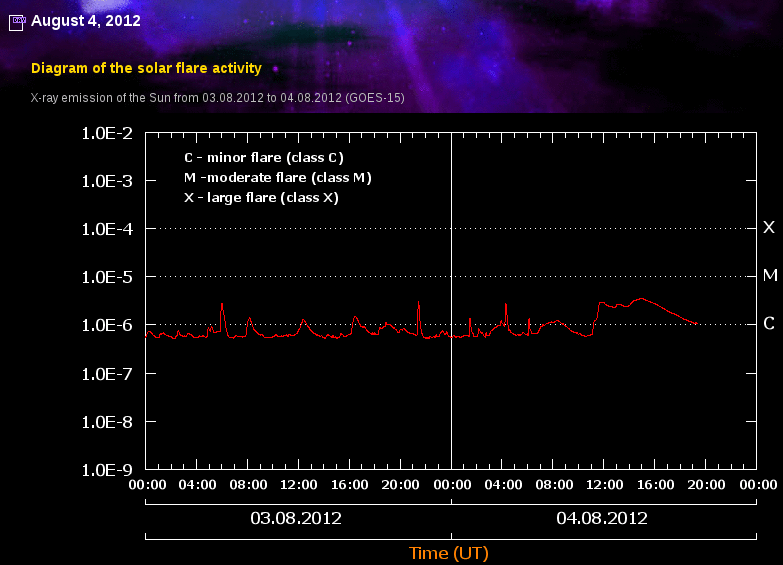
    Thanks for posting the Sun Flare Activity Report.

    It corelates with the aboove movie.

    IndianaBoys

    Originally posted by MonsieurM View Post
    so August 4th is here


    Leave a comment:


  • MonsieurM
    replied
    thank you IndianaBoys

    Leave a comment:


  • IndianaBoys
    replied
    ERUPTING MAGNETIC FILAMENT August 4, 2012


    ERUPTING MAGNETIC FILAMENT
    A filament of magnetism connecting sunspots AR1538 and AR1540 rose up and erupted on August 4th.

    As the filament ripped through the sun's atmosphere, it propelled a massive CME into space. The expanding cloud does not appear to be on a collision course with Earth, although a glancing blow might be possible 2 to 3 days hence.

    IndianaBoys

    Leave a comment:


  • IndianaBoys
    replied
    Originally posted by bhaas View Post
    Will we be able to any of the meteor showers here in Wa. State?

    Thanks
    Hi bhaas,

    This should answer that for you:

    The next meteor shower is the Perseids on the night of August 11
    2012 Meteor Showers | StarDate Online

    Thanks for asking,

    IndianaBoys

    Leave a comment:


  • bhaas
    replied
    Will we be able to any of the meteor showers here in Wa. State?

    Thanks

    Leave a comment:


  • IndianaBoys
    replied
    Early Perseid Fireball - August 2, 2012


    RIPPING PERSEID: As Earth enters a broad stream of debris from Comet Swift-Tuttle, more and more Perseid meteors are appearing in the night sky. "Last night, I captured a Perseid fireball ripping through the ionosphere over New Mexico," reports amateur astronomer Thomas Ashcraft. "It was traveling pretty fast - 133,000 miles per hour!"

    At the moment, Perseid meteor rates are low--no more than about 10 per hour. In the days ahead, however, Earth will plunge deeper into the comet's debris stream, and meteor activity will increase accordingly. Forecasters expect the shower to peak on August 12-13 with as many as 100+ meteors per hour visible from dark-sky sites.

    Leave a comment:


  • IndianaBoys
    replied
    Aia 131 (2012-07-18 23:30:57 - 2012-07-19 22:40:57 Utc)

    AIA 131 (2012-07-18 23:30:57 - 2012-07-19 22:40:57 UTC)
    AIA 131 (2012-07-18 23:30:57 - 2012-07-19 22:40:57 UTC) - YouTube

    IndianaBoys

    PS: - Very impressive video of the sun
    Last edited by IndianaBoys; 08-02-2012, 11:52 PM.

    Leave a comment:


  • IndianaBoys
    replied
    Powerful M7.7-class solar flare! (July 19, 2012)

    Powerful M7.7-class solar flare! (July 19, 2012)
    Powerful M7.7-class solar flare! (July 19, 2012) - YouTube

    IndianaBoys

    PS: - Very impressive video of the sun
    Last edited by IndianaBoys; 08-02-2012, 11:52 PM.

    Leave a comment:

Working...
X