-
-
This picture was missed.
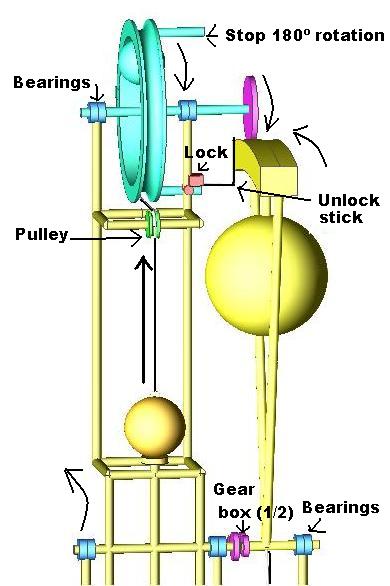
-
With direction of rotation and gear box multiplication

Comment
-
Comment
-
Hi Dave,
I certainly applaud your skills in evaluating the various possibilities and then giving us these great 3D representations of your ideas
Throughout history, mankind has had an intuition that the forces of gravity and magnetism somehow contain energy. These intuitions were proved true by science and have even been quantified. Unfortunately, it was discovered that all empirical tests revealed the same basic fact that these two fields were conservative.
A truly conservative field always 'nets' to zero. IOW, after all the calculations are done, the energy gains and losses end up balancing out. This arrangement also lead to another discovery that with conservative fields, the path taken becomes irrelevant to the ending net value.
Academics readily accept this because it is so widely supported by the hands on empirical testing and as of yet, has not been proven to their satisfaction. (See YouTube - ‪AdminOnDuty's Channel‬‎ and (See FizzX.org :: View topic - Magnetically Assisted Pendulum
) So even though some replicated proof does exist that is supported by mathematics as shown by user Jcmax, assumptions were made by there regarding how many degrees would be involved and a random number of 5 degrees was picked out of the air to cancel the gain. So the magnetic proof was discarded and a derogatory name (pendusmot) was arbitrarily attached to it to dissuade anyone from attempting to replicate or scale up the real gains demonstrated. So, when gains are brought to their attention, most academics assume they are in error by some way. But not all academics share such a view.
Professor Lewin at MIT came under serious scrutiny by his peers when he demonstrated a very critical factor with regards to these conservative fields. He proved two very important things in that test. The first thing he showed was that a changing field is not conservative. And the second thing he showed was that energy can be extracted in the middle of the change. When a field is non-conservative, it is no longer path independent. What that means, is that if you alter the path, you alter the energy when it is non-conservative= Force times Distance and Energy and Work can be equated by which essentially states that Work equals the change in kinetic energy of a body. Now lets attach a rubber band to the pedulum. We move the pendulum the same distance as before, but we have to put more energy in to stretch the rubber band. What happens when we let go . . . does the bob stop when the rubber band is completely contracted? No, whatever inertia exists in the bob, the momentum carries it on. Assuming the bearings on our device are perfect and non friction, how much mass (inertia) can we add to our bob before the rubber band simply cannot move it? Does the MOI (Moment of Inertia) prevent any movement until the force exceeds its value?
With gravity, the MOI is meaningless. It will move any mass and accelerate it at the same rate regardless of its density. Of course, in space the only thing pinning a planet to space time is its own inertia so the acceleration could be seen as the smaller object moving toward the larger, but really, at the smallest level (if such could be accurately measured) both bodies move toward each other. So if a meteorite is attracted to Earth, then the planet is likewise moved toward the meteorite by some small fraction of distance.
But back to the question, where does the 'extra' energy come from? As shown, the real energy put into the bob laying flat on the table is used up to move the bob from one end to the other - the definition of work. We apply a force with our fingers, the bob begins moving, we lessen the force and even apply a negative force to stop it. So there is a difference between the kinetic energy at the start, in the middle and at the end and those represent the work involved. Then when we add the rubber band, we V/dt. We can also rewrite this as F = mdV/dt which leads us to see that dt = mdV/ F Therefore we can in essence convert time to energy by applying a smaller force to a mass for a longer period of time and storing that energy in the momentum of the moving mass.
 Can we use Inertial Gravity against Mass Gravity to break the field into non conservative parts? If so, then can we extract energy from them?
Last edited by Harvey; 08-05-2010, 06:17 PM."Amy Pond, there is something you need to understand, and someday your life may depend on it: I am definitely a madman with a box." ~The Doctor
Can we use Inertial Gravity against Mass Gravity to break the field into non conservative parts? If so, then can we extract energy from them?
Last edited by Harvey; 08-05-2010, 06:17 PM."Amy Pond, there is something you need to understand, and someday your life may depend on it: I am definitely a madman with a box." ~The DoctorComment
-
Very nice post harvy, gave me a bit of reading material!Originally posted by Harvey View PostComment
-
-
Originally posted by StealthComment
-
Originally posted by Stealth
Hi Stealth
Thank you for introducing me to the Buzzsaw.
Did you see this?
YouTube - ‪Preston Stroud - BuzzSaw Gravity Wheel Replication - 13-Feb-10‬‎
Great craftsmen but he is run it back words. He has to increase the radius of the center of mass, on the way down and reduce it on the way up.
The pictures below show that the weights only fit if two wheels are used; I believe that one wheel is missing.
I show the direction on the pictures and the red wheel rotates twice the velocity of the exterior and they are connected, so one pushes the other and Vice versa.
It may work, because we are simulating a parametric pumping in which the gravity works more time on the weights going down, and then on the way up and on the red wheel the weights travel twice the velocity and with a smaller radius up.
Thank you
David
 Last edited by Matos de Matos; 08-11-2010, 10:15 PM.
Comment
-
the drawing did not show up

Comment
-
I haven't played around at all with the Buzz Saw Gravity Wheel, but when looking at it I would think that the inside wheel would turn clockwise and the outside wheel would turn counter clockwise.
MarkComment
-
Hi Stealth:Originally posted by Stealth
What a great though. Good thinking.
Do you think that if you put a spring on the interior where the ball hits when rolls inside, that spring could push the ball on the top when starts roll down.
Regarding the BuzzSaw, I did open a new thread, where I have the number of weights and the flow. I think that is off topic here, and deserves a wider participation because I am very confident that may be a torque over unity.
http://www.energeticforum.com/renewa...tml#post107029Comment
-
Just saw the Buzz Saw vid - I have to agree with Dave here that the the video is backwards - in many ways.
First, for his configuration, the outer wheel needs to have more slots than the inner wheel.
Secondly, the outer wheel needs to move slower than the inner wheel.
Third; The wheels need to move counter clockwise for the current arrangement of slots.
I think what we have here, in reality, what everyone saw working, is a two speed transmission. In the working unit, springs keep the weights pulled into the center and the drive mech has a two to one ratio. But when the RPM reaches a certain point, the weights are thrown outward and cause an interlock between the two wheels so they move at the same speed. I can see how these types of transmissions could be used to get the large mass of the Band Saw blades and their rollers up to speed when being driven by water wheels.
Another possibility is that the device was used as a type of over run clutch allowing the wheels to move freely in one direction but lock together in the other direction.
But let's say my intuition is wrong and the device did work as it was claimed. Then we have an outer wheel that moves twice as fast as the inner wheel and thus has a receptor waiting for input in synchronicity with the inner slots due to the 2:1 ratio of slots. This then allows twice as many weights to be in place on the inner wheel making the mass twice as much. Now we have the force of gravity pulling down on those 8 weights on the inner wheel and pulling down on those 4 weights on the outer wheel causing a differential of 4 weights. Now the torque on the wheels is relative to the mass, the radius and the applied force angles of both momentum and gravity (see Moment of Inertia) So first, what is the radius differential? Well, just to get a close approximation, I did get a pixel count and came up with a radius of 84.5 pixels radius on the inner path and 103.8 pixels on the outer path so there is a differential of about 22.5% which isn't a whole lot but it is something. Without exact measurements of weight and radius we cannot do any real world calculations here - the best that could be done are some comparisons based on various radii with a 22.5% differential and various weights to plug in the moment of inertia. Then we could see if having that momentum in the outer wheel offers more torque than that of the inner wheel so we can raise those extra four weights which would have a lower angular momentum. Also, since the outer wheel is moving faster, the weights will transfer their momentum to the inner wheel when they change velocity. This also means that gravity must accelerate the outer wheel to compensate for the introduction of a lower momentum weight at the point of entrance. These momentum exchanges will be there even if we swap the roles of the wheels and try and use the heavier 8 weights to drive the outer wheel - the outer wheel must still accelerate the weight and double it's velocity and the inner wheel must decelerate the weight and halve the velocity. It would seem that the momentum exchange would be balanced either way, what is taken at the one end is put back at the other.
From a strictly gravitational leverage point of view, the torque will be rFsinθ for each weight where F represents the Force of Gravitynegative gravitational torque of 3137.06 N on the outer wheel at that instant in time
So it would seem that even though the inner wheel has less leverage, the doubled weights provide an advantage to lift the outer wheel.
But . . . can it lift it at twice the velocity? For that we need to know if the device is able to run smoothly or if it is surging (see impulse force) with the introduction of a new weight. The weight must be accelerated over some distance as small as that may be, in a given qty of time. And those are all unknowns and difficult to calculate. Even my above calculations differ as the weights move into a top and bottom position placing two out of nine weights at a sin(0) or sin(180) position either of which results in zero force and only gives us 7 weights in play. So it does take some complex math to sort it all out correctly.
It would seem that the inertia and momentum involved would net to zero but there will always be some losses in the transitions. Perhaps someone else would like to tackle the math on that. It is a bit difficult to visualize a smooth transition between wheels without something getting wedged or slammed. There must be some mechanism to ensure the timing and prevent locking.
 "Amy Pond, there is something you need to understand, and someday your life may depend on it: I am definitely a madman with a box." ~The Doctor
Comment
-
Hi Harvey:Originally posted by Harvey View Post
I just found this, Directory:BuzzSaw Gravity Wheel - PESWikihttp://www.energeticforum.com/renewa...tml#post107029 has always 4 weights coming down on the left half of the yellow wheel, and the right half that goes up is empty.
The red wheel has 2 weights going up on the right half, none on the other half and with double the velocity of the yellow wheel.
Very slow, to give time for the weights to roll, may work.
When you have the time I would like to ear your opinion on the:
http://www.energeticforum.com/renewa...how-i-see.html
Thank you
DavidComment

 Tweet
Tweet


Comment