
 Tweet
Tweet
Originally posted by Duncan
View Post
 . Wavelength is the unit of the electromagnetic wave. It certainly isn't the unit of the longitudinal wave . although it may be said to have a period. As I'm asking you to consider the electrical (equivalent) affects of this wave after what you may consider the (equivalent) of demodulation it is essential that you grasp the nature of it.
A longitudinal wave has a wavelength. Wavelength is the distance between any one point and the same point in the next repeating cycle. That is the length of the full wave, or one whole cycle.
If a longitudinal wave didn't have wavelength and frequency then there would be no such thing as music as it would be impossible to play any pitch (frequency).
A sine wave can be representative of anything. It's a value that changes over time.
A picture of a sine wave represents a longitudinal wave just as well as it represents a transverse wave. The compression and rarefaction zones are distributed as a sine wave.

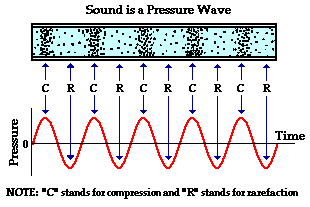

A longitudinal wave can be sine or anything else, which is how it's possible to produce different sounds.
If you press a button softly and increase the pressure gradually before easing off the pressure again, the pattern it produces when pressure vs time is plotted on a graph is a sine wave. Switch the button on and off and the graph gives you a square wave. Vary it in any given fashion and you produce all kinds of waveforms. Value over time.
acoustics - How can a sine wave represent a longitudinal wave? - Physics Stack Exchange
AT&T Archives: Similiarities of Wave Behavior (Bonus Edition) - YouTube
Sine waves have nothing to do with propagating through space while still looking like a sine wave. It's a visual representation of how the value of some variable changes over time.



 don't know if they are posted anywhere

Comment